


Test your instincts: We used ChatGPT to plan the exit of our minority director — how exposed are we?
Think you’d make a good judge? Read the facts, weigh both sides, then back the argument you think wins. We’ll tell you how the Court actually ruled... and why.
The Scenario
Picture three equal director-shareholders of a successful defence consultancy built on mutual trust. [2] Two of them decide the third is underperforming, turn to a generative AI tool for an “HR problem resolution” plan, implement a performance-management approach drawn from employment frameworks, shut the minority out of key contracts and withhold dividends. [77] Does that course of conduct, even if the majority genuinely believed the minority was not pulling its weight, cross the line into oppression under s 232 of the Corporations Act 2001 (Cth)? [265] And if it does, what remedy is available when the majority claims it cannot afford a buy-out and expert valuations are irreconcilable? [266]–[340]
This is the puzzle the Court had to solve.
The Facts
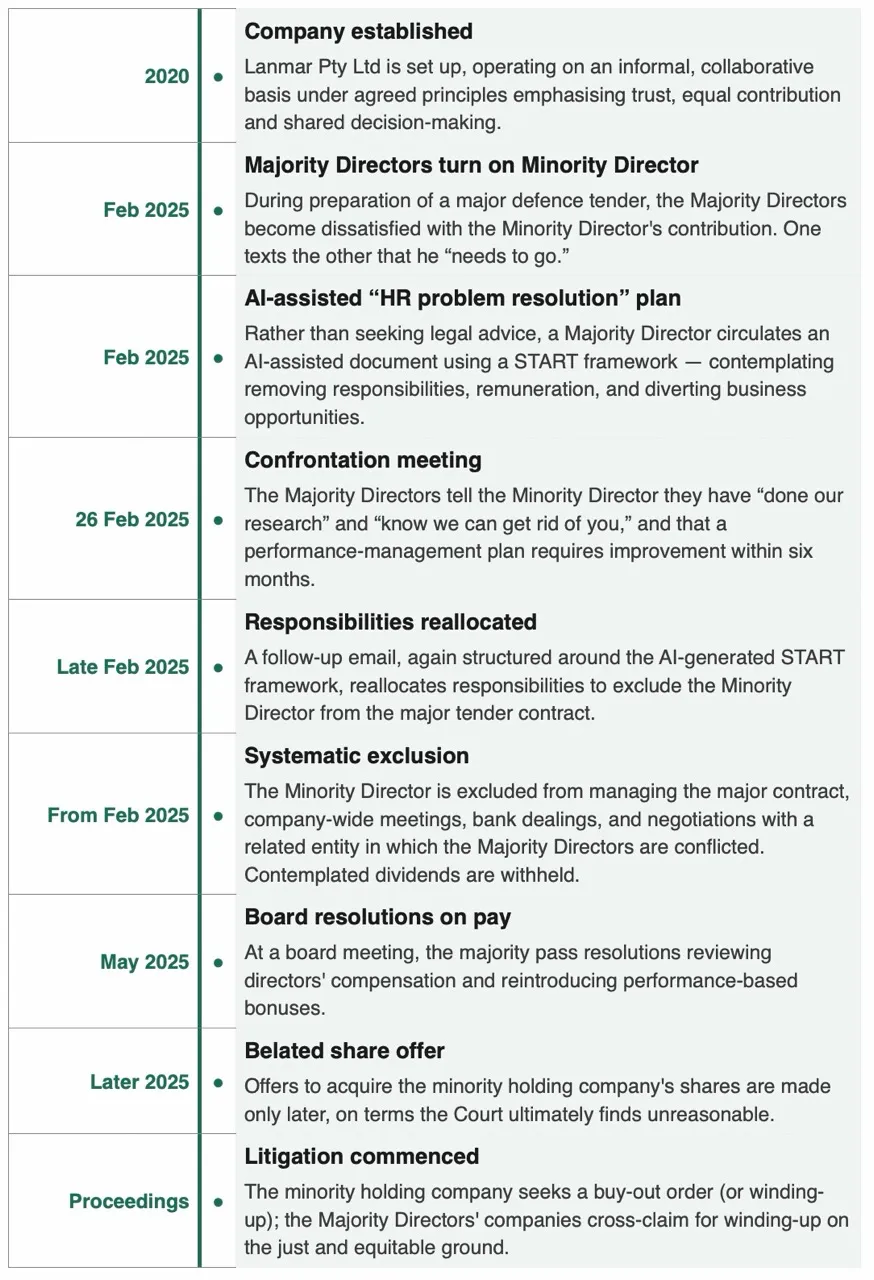
One holding company associated with the Minority Director held one-third of the shares in the Company; the two other holding companies associated with the Majority Directors each held one-third. [2] The three individuals were the directors of the Company, which provided engineering, asset management, advisory and consulting services primarily to the Commonwealth and the Department of Defence. [2] The Company was established in 2020 and operated on an informal collaborative basis under agreed principles emphasising trust, equal contribution and shared decision-making. [8]
In February 2025, the Majority Directors became dissatisfied with the Minority Director’s contribution. [68]–[72] One Majority Director texted the other that the Minority Director “needs to go”. [68]–[72] Rather than taking legal advice they turned to ChatGPT. [77] One Majority Director circulated a ChatGPT-assisted document headed “HR problem resolution” that framed the issue as an employment matter and deployed a “START” (Situation, Task, Action, Result, Target) framework. [77]–[86] The document contemplated removing responsibilities, removing director remuneration and even diverting business opportunities to other companies. [77]–[86]
At a meeting on 26 February 2025 one Majority Director told the Minority Director that they had serious concerns about his performance, had lost confidence in him, had “done our research” and “know we can get rid of you”. [89]–[93] The other Majority Director stated that a performance-management plan had been put in place requiring significant improvement within six months. [89]–[93] An email sent after (but drafted before) the meeting, again structured around the AI-generated START framework, reallocated responsibilities so as to exclude the Minority Director from operational involvement. [94]–[98]
Thereafter the Majority Directors systematically excluded the Minority Director from management. Dividends that had been contemplated in cash-flow models were withheld.
At a board meeting in May 2025 the majority passed resolutions reviewing directors’ compensation and reintroducing performance-based bonuses. Offers to acquire the minority holding company’s shares were made only later and on terms the Court ultimately found unreasonable.
The minority holding company commenced proceedings seeking a buy-out order under s 233 or alternatively winding-up; the Majority Directors’ companies cross-claimed for winding-up on the just and equitable ground. [1]
Your call — which side has the stronger case?
You’ve seen the facts. Now it’s your call.
The minority’s case
- The AI-derived strategy wrongly treated the Minority Director as an employee rather than an equal director-shareholder in a quasi-partnership company governed by the Corporations Act. [77]
- Exclusion of a quasi-partner from management without a reasonable offer to acquire his shares constitutes oppression under s 232, regardless of any genuine performance concerns. [265]
- The majority’s course of conduct from February 2025 — reallocation of responsibilities, exclusion from the major contract and other operational matters, withholding of dividends and conflicted dealings with a related entity — was oppressive, unfairly prejudicial and unfairly discriminatory. [265]
- Even if the majority believed they were acting for proper purposes, that belief does not prevent a finding of oppression. [248]
- A buy-out order, or alternatively the appointment of a receiver to sell all the shares en bloc, was the appropriate remedy so as to preserve the going-concern value of a solvent and successful business. [266]–[340]
The majority’s case
- Any performance concerns about the Minority Director were genuine and justified the steps taken to redefine roles and responsibilities. [248]
- Differences in contribution and the need to protect the company’s interests in the major tender justified the majority’s exercise of voting power.
- Offers were made to acquire the minority shares and the majority lacked the capacity to fund an immediate buy-out at the values contended for by the minority. [266]–[320]
- Winding-up on the just and equitable ground was appropriate given the breakdown in mutual trust and confidence. [1], [344]–[349]
- The appointment of a receiver to sell shares was unnecessary or inappropriate.
Good instincts. The Court sided with the minority. Here’s how it got there.
Not this time. The Court sided with the minority. Here’s where the majority’s argument fell down.
The Court’s Decision
In the matter of Lanmar Pty Ltd (No 2) [2026] NSWSC 800 Black J noted that ChatGPT did not prove to be a prudent choice of adviser so far as matters of Australian corporate law were concerned. [77] ChatGPT incorrectly approached the issues from an employment law perspective when they ought to have been approached under corporate governance laws. [93] The reliance on such flawed ‘advice’ led the Majority Directors to carry out the course of conducts that ultimately amounted to oppression.
The underperformance of the Minority Director, whether as perceived by the Majority Directors or as a fact, did not provide a basis for his substantial exclusion from participation in the company without a reasonable offer to buy out the minority shareholder’s shares at fair value.
The departure from the parties’ understanding of dividends payment – i.e. the withholding of dividend payments, combined with the Majority Directors resolving to review directors’ compensation, implementing an incentive plan and delaying bonuses, were directed to removing income that would be received by the shareholders while reserving the Majority Directors’ ability to receive additional income. These amounted to oppression. [258]
On remedy, the Court declined a buy-out order because it was unable to accept the valuations reached by the parties’ expert. [316] The Court accepted that a sale of the company’s shares, compared to a winding up, was less likely to destroy the value of a solvent and successful business. Ultimately, the Court appointed receivers for an en-bloc sale of all the shares, preserving the business while the market determines price. [340]
Conclusion
This case demonstrates the limits and risks with relying solely on generative AI – although it can generate advice that is seemingly correct and convincing, there is no guarantee that the advice is correct. ChatGPT’s advice may or may not be correct in the context of employment law, but the fact that it overlooked the point that the Minority Director was a director and controller of one of the three shareholders was detrimental. The Majority Directors should have turned their minds to, or be advised of, the risk of oppression for the purpose of the Corporations Act 2001.
Holding a majority voting power also does not entitle the director/s to do whatever they consider appropriate. Such power must still be exercised having regard to the company’s constitution, shareholders’ agreements and the laws. Notably, directors must comply with their duties under the Corporations Act 2001. In this case, the majority directors’ conducts also raised the issue of whether there was a breach of their director’s duties. Forcing out a minority shareholder or director can still attract disputes.
However capable generative AI is, obtaining professional legal advice remains important.

About Sharrock Pitman Legal
Since 1967, Sharrock Pitman Legal has made a significant and long term contribution to meeting the legal needs of business owners and residents in the City of Monash and the greater Melbourne area.

About Sharrock Pitman Legal
Since 1967, Sharrock Pitman Legal has made a significant and long term contribution to meeting the legal needs of business owners and residents in the City of Monash and the greater Melbourne area.

Meet our team
Sharrock Pitman Legal is a high performance law practice, totally focused on exceeding your expectations with service, skills and solutions second to none.


